
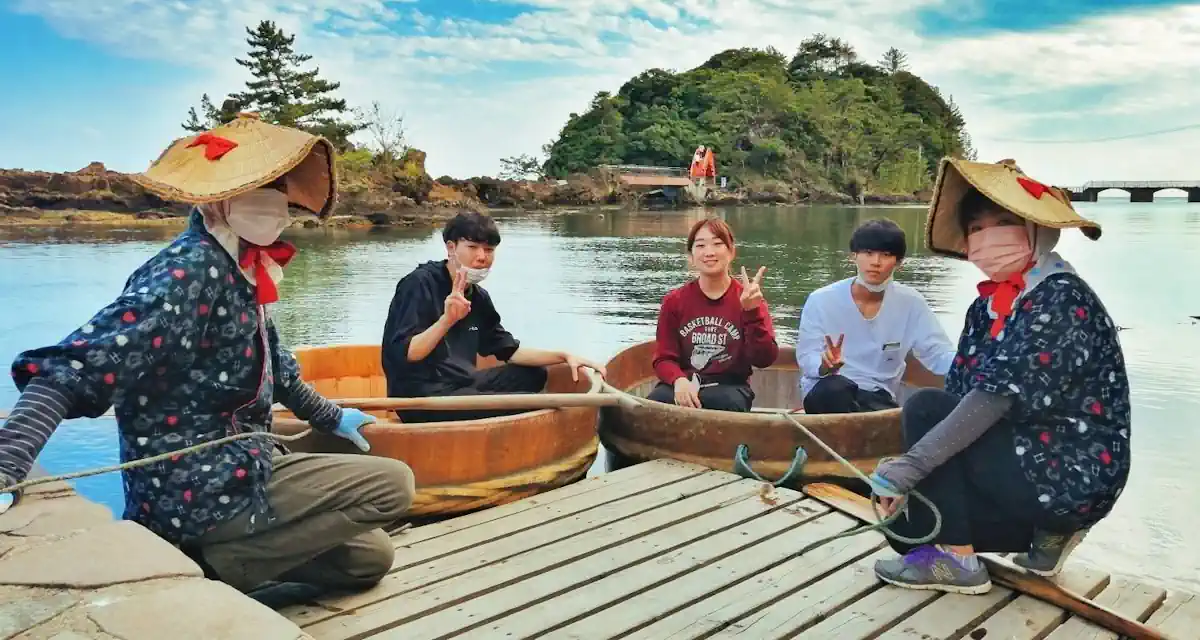
Description
Highlights
Stay at Koninji Temple or in a furnished tent
Craft bamboo toys with local school children
Help maintain biotopes and rice fields
Clean Sobama Beach and learn about pollution
Explore Chokokuji Temple and its history
Introduction
Our Environmental Conservation Volunteering program with countryside immersion into Japanese traditional rural culture on beautiful and remote Sado Island is an opportunity you won’t find elsewhere in Japan:
You will stay on the grounds of the historic Chokokuji Temple in a spacious, fully furnished tent in the temple’s gardens.
You will join a variety of volunteering activities (Monday to Friday) related to environmental conservation, preservation of cultural heritage and farming. There are also educational environmental sessions and workshops. Please see our sample itinerary.
As part of local communities you will have the chance to get to know a piece of rural and traditional Japan, which is typically not accessible to you as a normal tourist or when staying at larger cities.
Sado Island is scenically beautiful with high mountains and a rocky coast that has crystal blue waters and white sandy beaches. It is sparsely populated. Due to its gold and silver mines that opened in Edo Period, people from all over Japan came to Sado and brought their culture. Hence, Sado is known as a melting pot of Japanese cultures and traditions and known for a variety of traditional forms of drumming, theater, handcrafts and food.
On this program we also always have Japanese volunteers, which stimulates an exchange of culture and language.
The minimum duration of stay is one week, but depending on your visa and the season, you can join the program for up 12 or more weeks.
If you would like to join for more than one week, kindly contact us and we would send you a custom offer to book via tourradar.
The costs are: 670 USD for the first week and 360 USD for any additional week from the 2nd week. This includes 4-share accommodation, full board, all program activities and arrival/departure transfers on Sado Island.
Upgrade 4-share to twin: +70 USD per week; Upgrade 4-share to single: +110 USD per week.
The project is operational every year from the first Monday of April to the third Monday of October. The itinerary shown here is a sample plan of weekly activities. The actual activities are chosen depending on the season and needs of our local partners, but are all similar to the sample plan. Activities are usually done Mondays to Fridays only, with the weekends being off. During the summer months (July and August) we usually do activities on 7 days per week. Meals are included on 7 days per week.
Itinerary
Day 1 Arrival at Sado Ferry Terminal & transfer to accommodation
You will be picked up on a Monday from Ryotsu ferry port of Sado and brought to Chokokuji Temple, the accommodation and base of the Mother Nature Conservation program in Japan. You will move into your large fully-furnished tent.
The rest of the day is free for you, so you can enjoy it at your leisure, meet other program participants and explore the beautiful hilly landscape around the temple. In the evening you can enjoy buffet-style dinner at the temple.
Please note that program activities are usually from Monday to Friday and you will have the weekends off. Only during the summer months (July/August) we usually run activities on 7 days per week.
After breakfast, you will get an orientation and introduction about the purpose of the environmental conservation program, local life and culture of Sado and the program logistics.
You can then join the volunteering activities, which might be preparing for a bamboo handcraft workshop with local school children. Bamboo is an extremly fast growing material that can replace plastic and other less sustainable materials in a variety of applications. A carpenter and artist specialising in bamboo will show you how to make objects such as toys, cutlery and music instruments from bamboo. You would then, together with other volunteers, teach this to local Japanese school children. Between April to June, the volunteer work can also include collecting bamboo shoots in forests that are used in primary school canteens for food.
Note: This is a sample itinerary. The activities are similar in nature, but are regularly changing depending on the season and local needs
After breakfast we drive to the rice fields of Iwakubi. In between the rice fields is a zone that is managed as a biotope. It is designed to be an ideal habitat for amphibians, fish and other small animals that feed the Crested Ibis. For this purpose, certain plant species are planted, and water levels are controlled, connected to the irrigation systems of the rice fields. Regularly grasses and bushes need to be cut, so that the birds have access to the water surfaces. In addition, the existing animal and plant species must be regularly monitored and their density determined.
As a volunteer, you will learn about the management of biotopes, the presence of which is, of course, also beneficial for many other species of animal and plants besides the Crested Ibis.
After you enjoyed your obento for lunch, the volunteering activity in Iwakubi continues. We might for instance help elderly farmers with maintenance of the historic irrigation system.
At around 5:30 pm you return to Koninji temple and have dinner at 7 pm. Please use the night to tidy up your room and tent since new participants might arrive the next day.
Note: The activities of the day are just an example and subject to change. Program activities are offered only from Monday to Friday. The weekends are usually off.
Chokokuji Temple was built in the year 807, which is the largest temple complex of Sado and known for its national cultural treasures such as statues from the 10th-12th centuries as well as its gigantic trees, to which spiritual powers are attributed. As a volunteer, you join light maintenance and renovation work, light gardening work, and/or preparing activities for groups of children that are visiting the temple. In the afternoon the monk will guide you through the temple and tells some fascinating stories about its history and Buddhism in general.
Note: The activities of the day are just an example and subject to change. Program activities are offered only from Monday to Friday. The weekends are usually off.
We drive to Sobama Beach, a beautiful wide beach not far from the temple. Our group is split into 2-3 smaller groups and we will collect plastic trash and lost fishing gear from the beach and the breakwater in front of the beach as a competition. Often children staying at a local campsite are joining this. The winning group wins a little prize. We will also learn about the problem of ocean and coastal pollution. During the summer months, we bake pizza in a stone oven on the beach and experience the beautiful sunset.
On the same day we also often visit the historic fishing village of Shukunegi which has remained mostly unchanged since Edo period.
Note: The activities of the day are just an example and subject to change. Program activities are offered only from Monday to Friday. The weekends are usually off.
We would listen to a small session exploring reasons how agriculture is the cause for loss of or can help to protect biodiversity. We would then drive to a farm that does both industrial farming and organic farming where we help the farmer, listen to the farmer’s experiences and compare the two approaches to farming.
Similar sessions on environmental topics followed by a small research task or practical task, include the topics of climate change, coastal pollution, overfishing and others.
Note: The activities of the day are just an example and subject to change. Program activities are offered only from Monday to Friday. The weekends are usually off.
The Crested Ibis (“Nipponia nippon”) is a bird with a size of 54-88 cm and a wingspan of 140 cm, which until the onset of industrial agriculture in the mid-20th century was relatively common in Korea, China, Japan and parts Russia, but is now threatened with extinction by losing its habitats. In 2002 there were only around 150 Nippon Ibises left worldwide. In Japan, the species was extinct in the wild in 2003.
As a result, the government of Japan, in cooperation with the Chinese government, launched an internationally recognized reintroduction program on Sado Island, where Crested Ibises from China were bred in captivity and released since 2008. The first hatchings in the wild were observed in 2012. Today there are again around 440 ibises on Sado Island, some of which were even spotted on the neighboring main island of Honshu.
We will visit the Rehabilitation Center for the Crested Ibis and learn about the program.
Essential for the survival of birds in the wild are the presence of suitable habitats. This includes traditional rice farming methods and the design of paddy fields including zones where the birds can feed throughout the year, as well as biotopes optimised as feeding and breeding grounds for the ibis.
The inclusion of Sado rice farmers and the promotion of traditionally grown, high-quality organic rice from Sado Island have been crucial to the success of the reintroduction program. We work with the rice farming community of Ogura. The terraced rice fields were built on steep slopes in the 17th century and can therefore only be worked by hand or with small hand-held machines, which makes their operation not commercially profitable. They are only maintained to prevent landslides and as a food source for the Crested Ibis. Rice is planted in April and harvested in October. During other months, the irrigation system, which includes a canal bringing water from a 17th-century water reservoir to the rice fields, needs to be checked and repaired. The edges of the paddy fields need to be fortified regularly with certain soils to keep the water on the fields.
Note: The activities of the day are just an example and subject to change. Program activities are offered only from Monday to Friday. The weekends are usually off.
In the morning, right after breakfast, you accompany the herbal experts of a small company from Sado into the forest. You help them to collect wild herbs and tree leaves and listen to their explanations of the plants. After lunch, you can then learn and help to clean, dry and grind the herbs and leaves and process them into herbal tea blends in the company’s premise. As a souvenir you can take your own tea blend with you.
If you have booked a stay for the minimum amount of one week you would be brought back to the Ryotsu ferry port of Sado for your departure. If you stay for more than one week, there will be other activities on the 8th day and the following days.
Note: The activities of the day are just an example and subject to change. Program activities are offered only from Monday to Friday. The weekends are usually off.
What’s Included
- Accommodation
Chokokuji is one of the largest and culturally most important temples on Sado Island. It is still actively run for religious services, even though the monk is over 80 years old.
The temple is said to have been founded by the Buddhist saint Kukai in the year 807. It has a large number of cultural assets, including three eleven-headed Kannon statues declared as Nationally Important Cultural Properties, created by the saint himself. Those statues are only unveiled to the public once every 33 years, and the next viewing will be in 2034. Additionally, there are statues of Kongo Rikishi (two wrath-filled guardians of the Buddha) made in the Heian Period (10th-12th century), and Gochido Hall, which is a prefectural cultural asset. In 2018, the current monk, Tomita, added a large stone “rabbit kannon” statue that is dramatically illuminated at night and has gained attention on Japanese TV. In Buddhism, Kannon is a bodhisattva, a being who has achieved enlightenment but chooses to remain in the cycle of birth and death to help all living beings attain liberation. Kannon is particularly associated with compassion.
Within the temple’s grounds, there are three very large cedar trees to which spiritual powers are attributed. They are estimated to be more than 1000 years old, and there is also a Japanese Umbrella-pine tree that is more than 500 years old. These ancient trees are classified as prefectural natural monuments. The monk puts a lot of effort into maintaining the temple’s gardens, which are colorful in all seasons with a variety of flowering plants, including azalea, hydrangea, and cosmos. Every year in May, the temple arranges a botanical festival.
Japanese and foreign tourists visit the temple throughout the year, mostly during the spring to autumn, and can get guided tours and spiritual experiences such as writing out sutras, zen meditation, and Buddhist sermons. The monk also arranges activities for school classes visiting the temple, such as making handcrafts.
You will stay in a large, fully furnished tent in the temple’s garden. The tents can be booked for single, twin, and 4-share occupancy. There are 2 showers with hot and cold water, exclusively for the use of our volunteers, and toilets at the temple. There are indoor and outdoor communal areas for sitting, taking meals, and as a workspace. For your convenience, we provide rechargeable flashlights/lanterns, sleeping bags and umbrellas in the tents. Delicious Japanese cuisine is offered in buffet-style three times per day.
- Guide
- Personal support staff at your location and at our international office
- Project coordinator and support staff guiding the daily activities (Monday to Friday)
- Meals
- Breakfast at Chokokuji Temple
- Buffet style lunch taken either at Chokokuji or at the location where volunteer work is done during daytime
- Buffet style dinner at Chokokuji Temple
- Unlimited drinking water, coffee and tea
This tour offers Vegetarian food option on request. Simply let World Unite Japan KK know the food option that you prefer.
- Additional Services
- Participation in all program activities (offered on at least 5 days/week)
- Orientation and Introduction at Chokokuji about the program activities
- Access to the World Unite! Online Resource Centre which has preparation materials including intercultural preparation, compiled particularly for your destination (mobile phone friendly Knowledge Base)
- Individual consultation and preparation prior to your arrival
- Preparation Session via zoom, together with other participants
- Support with the travel from Tokyo to Sado by our Tokyo team.
- 24 hours emergency support by local support team
- For the CO2 compensation of your long-haul flights: Costs for 10 seedlings of indigenous trees that we plant on the slopes of Kilimanjaro in Tanzania
- Issuance of confirmations/certificates for your university, scholarship, insurance, etc. and filling out/signing internship contracts for your university
- Transport
- Pick-up and transfers from/to Sado (Ryotsu) Ferry Terminal on arrival and departure to/from Mother Nature Camp Sado
- Transfers for all program activities on Sado Island
- Free eSIM
TourRadar offers the lead traveler (the person who booked) a free 1GB eSIM for the trip. The eSIM is redeemable only through the TourRadar app 72 hours before departure.









Reviews
There are no reviews yet.